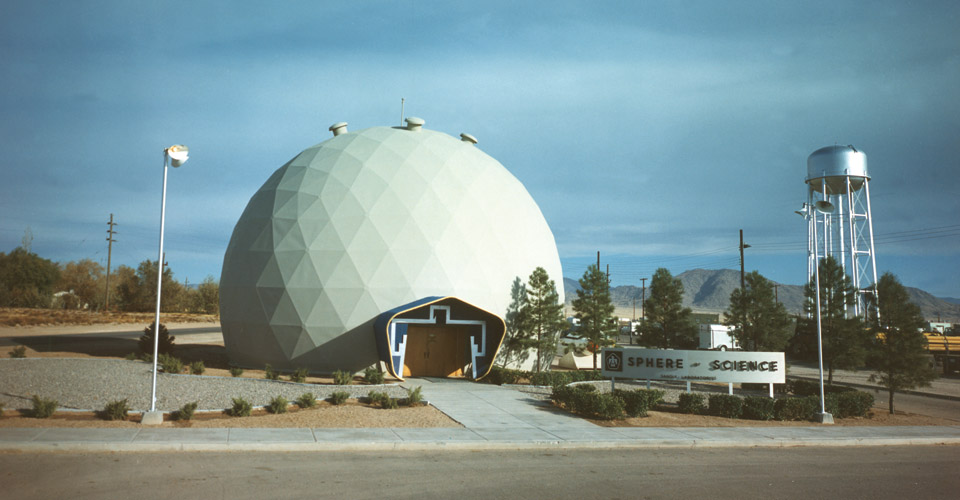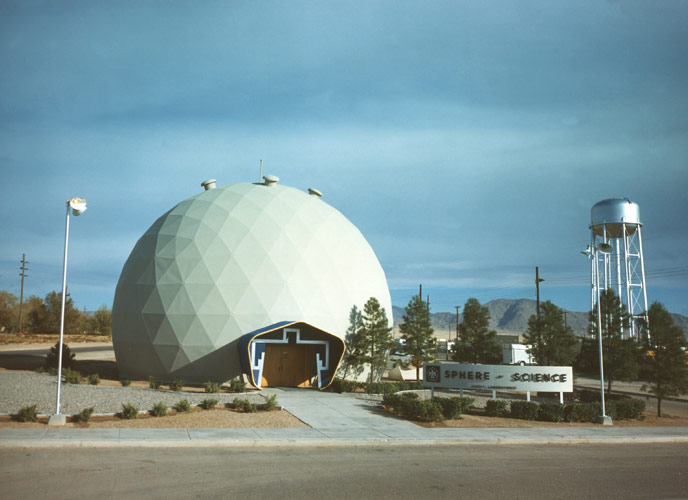
From 1959 to 1978, the Sphere of Science served as a visitor center and introduction to Sandia’s technical work. More prosaically identified as Building 852 and sometimes referred to as the dome or golf ball building, the Sphere contained unclassified exhibits on Sandia’s nuclear weapon design activities and achievements. Its primary audience included local educators, scientific societies, employment candidates, engineering and technical conference attendees, and service organizations. It also became Sandia’s official entry point for dignitaries and foreign visitors.
The State Fair
In 1956, Sandia’s Public Relations Division organized the first exhibit on the Labs’ activities for the New Mexico State Fair. Featuring working models of Sandia’s environmental test facilities, the exhibits were in a 40-foot booth in the west wing of the Dairy Building towards the north end of the midway. An 80-foot balloon outside the building called attention to the Sandia display and doubled as an experiment, as members of Sandia’s Field Test Division gathered drag data and wind velocity measurements.
Inspired by their 1956 success, Public Relations planned an even bigger State Fair show for 1957. All Sandia exhibits were housed in a large balloon-type inflated structure 80-feet long and 40-feet wide. Unfortunately, two weeks before the fair opened, during a not uncommon windstorm, the balloon ruptured and blew out of the fairgrounds. The balloon tent was replaced by a pre-fabricated Butler-building in time for opening day.
Weather-wary, Sandia borrowed a geodesic dome from Lincoln Laboratory to display exhibits at the Fair in 1958. Lincoln Lab built and used geodesic domes to house the radar antennas for the Distant Early Warning System (DEW Line). The dome measured 40 feet high and 55 feet wide and was constructed of fiberglass triangles bolted together to form a three-quarter sphere. Night visitors could easily find the exhibit, as it glowed pale green. 82,000 visitors viewed the exhibits at the geodesic dome during the 1958 Fair; it was so popular that the exhibit remained open in the evenings and on Saturday for an additional week after the Fair’s end.
Building on its success and the need for a space to host visitors, Sandia proceeded to obtain a geodesic dome of its own and installed it in May 1959 just outside of the Labs’ Tech Area I, at the southeast corner of F (now Frost) Avenue and 12 th Street. One feature of geodesic domes is that they are easy to install and to move. That fall, the dome was moved to the State Fair for another successful run. 110,586 people visited the Sphere of Science at the 1959 New Mexico State Fair.
Sandia at the 1958 Fair
The Sandia Lab News covered detailed preparations (PDF) for the 1958 State Fair.
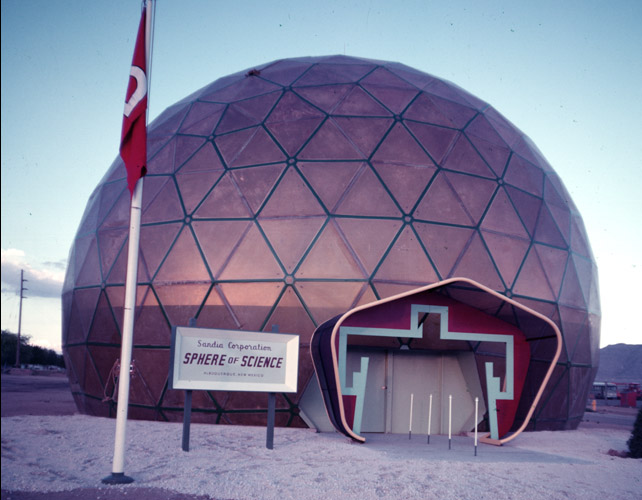
The 1958 Dome – Borrowed from Lincoln Laboratory, the geodesic dome to house Sandia’s exhibits at the 1958 New Mexico State Fair appeared more coppery than the later, more starkly white dome Sandia purchased.
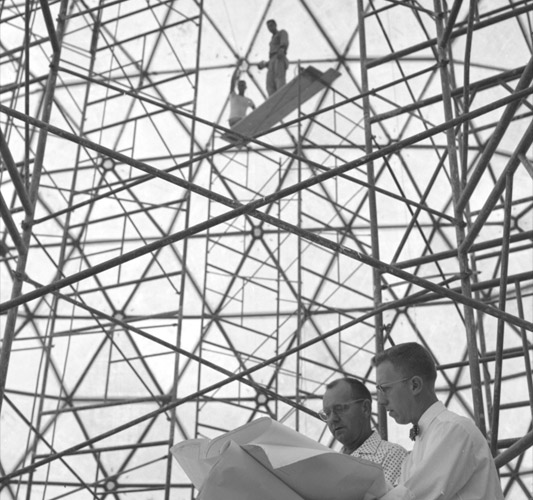
Installing the Dome at the 1959 Fair – Moving and setting up a geodesic dome is supposed to be pretty easy.
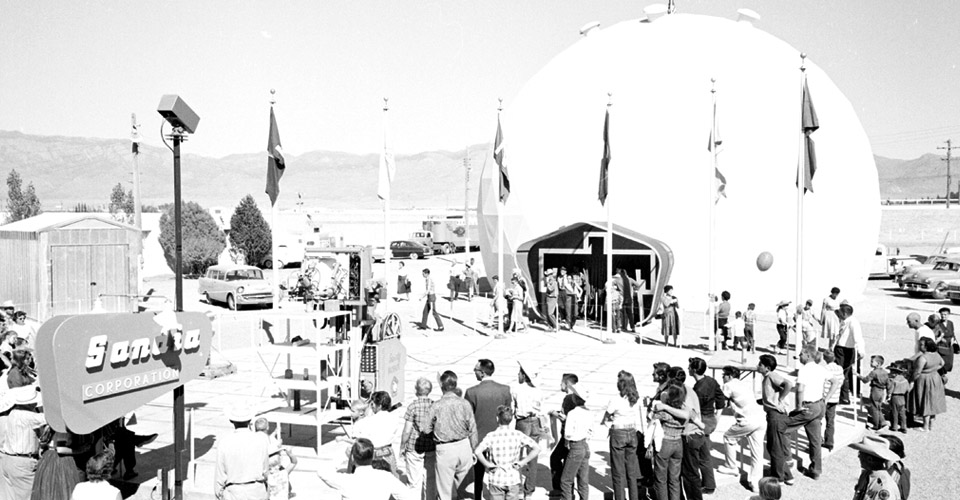
Opening Day at the 1959 Fair – Visitors gather to experience the wonders of the Sphere of Science in 1959.
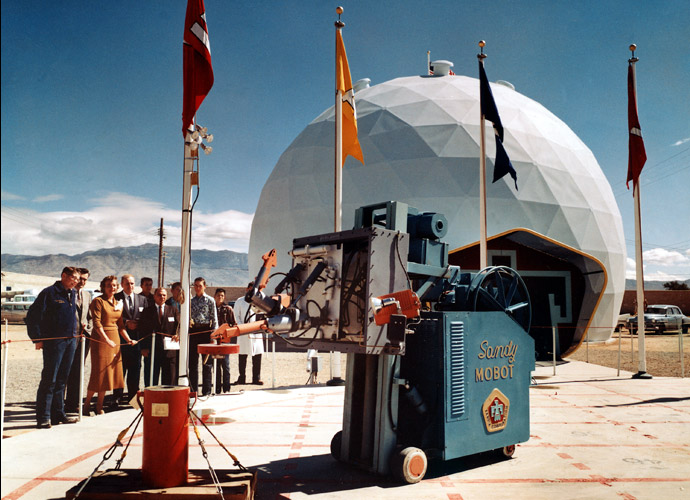
Sandy Mobot – Sandia displayed the robot it designed for remote handling of radioactive materials on a concrete pad outside the entrance to the Sphere of Science. Dubbed Sandy Mobot, the robot was operated by a Sandian inside the Sphere.
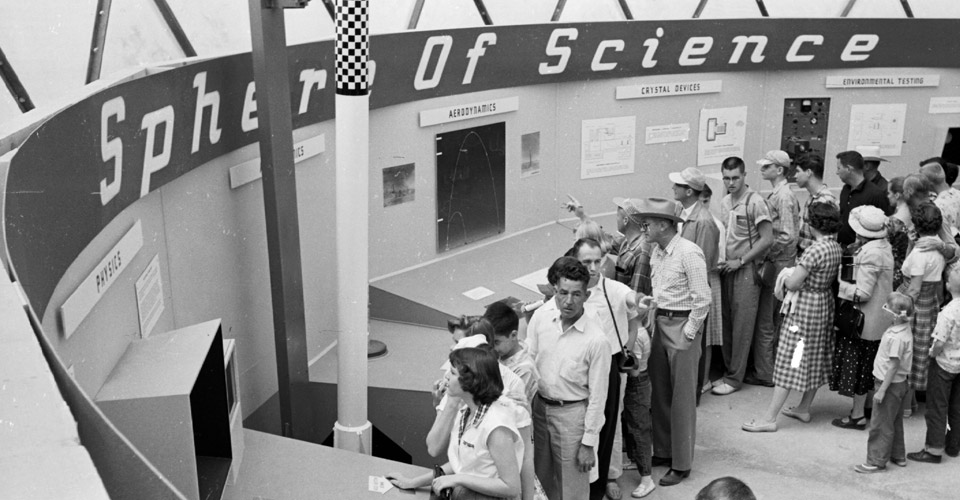
Crowds Inside the Dome at the 1959 Fair – State Fair visitors peruse the exhibits in the Sphere of Science.
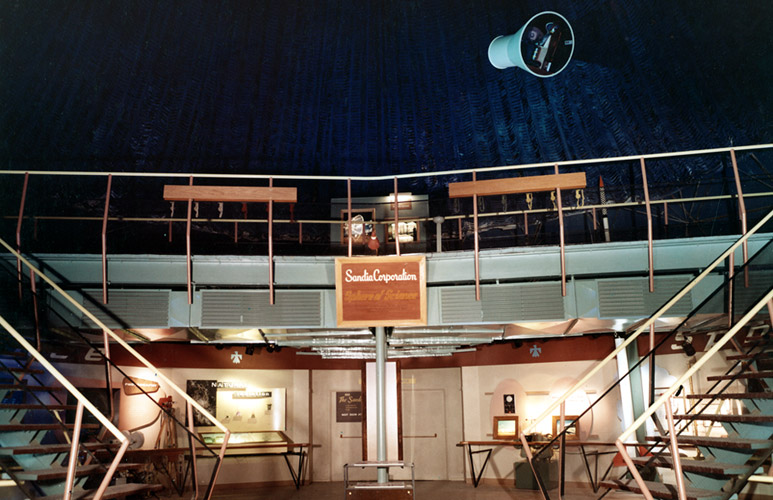
Entering the Sphere – Exhibits lined the interior walls of the dome on the first floor and on the mezzanine. They also sat in the interior spaces and were suspended from the ceiling.
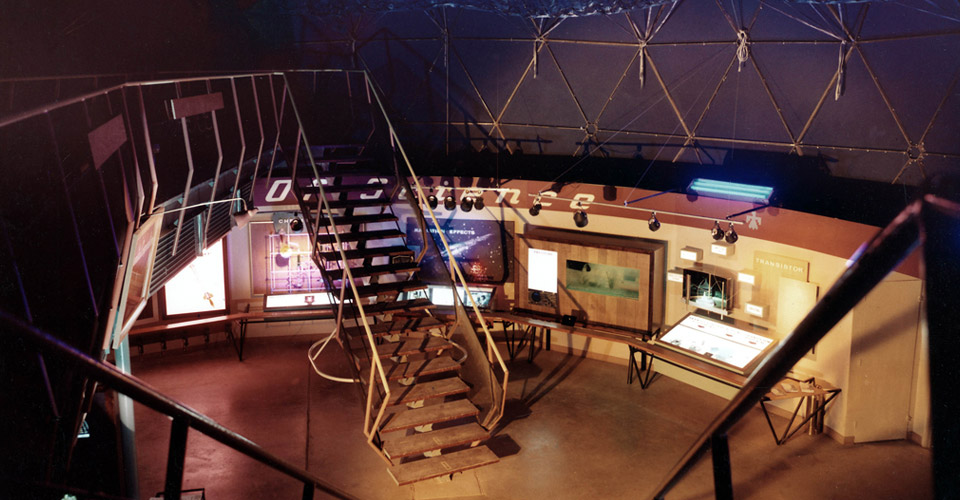
The Ceiling – The interior of the dome was draped with a parachute, representing Sandia’s recently acquired expertise in parachute design to support laydown weapons. The earlier nuclear weapons were designed to drop and detonate at a specified altitude. By the mid-1950s, specifications included the ability to drop a nuclear bomb, have it rest on the ground, and detonate at a specified time. This required retarding the bomb’s fall and Sandia researched and developed an advanced capability in parachute design.
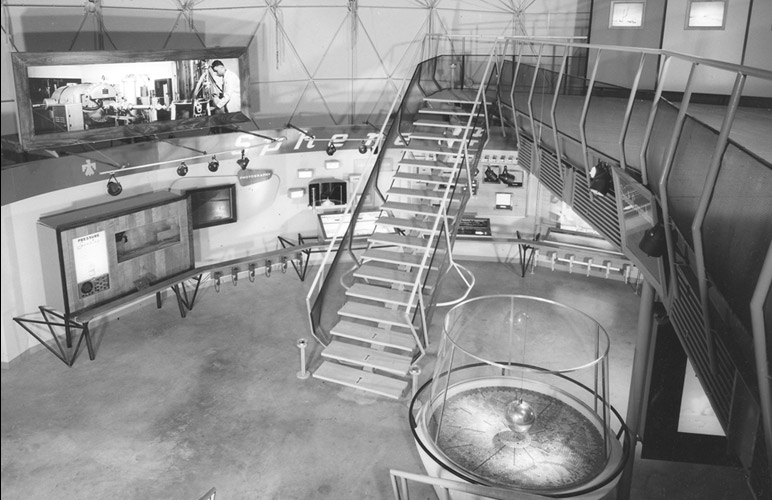
The Foucault Pendulum – A 350-pound lead-filled aluminum pendulum hung suspended from the center of the Sphere over a “mosaic polar view of the earth.” This exhibit recreated the 1851 experiment of French physicist Jean Foucault to demonstrate the rotation of the earth. The pendulum made a complete revolution in 41 hours and 47 minutes.
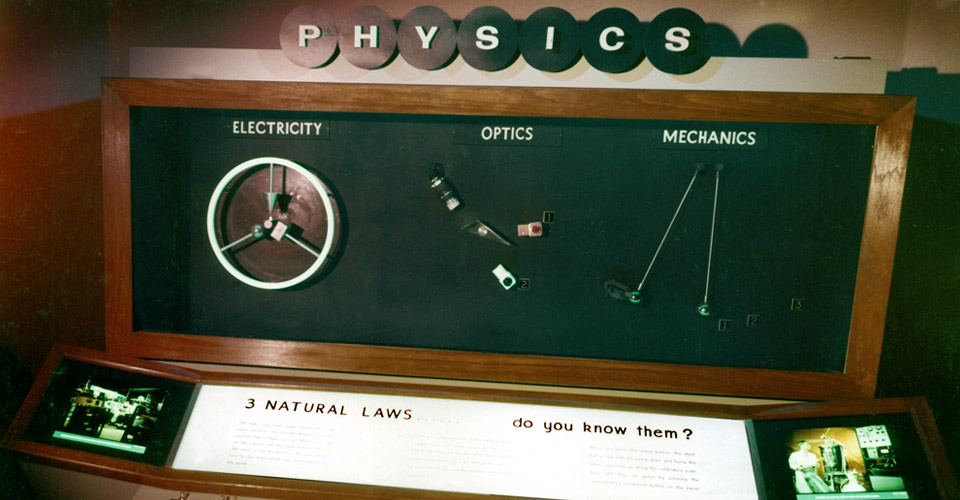
Physics – This exhibit recounted the many ways that SNL used physics in its work. It allowed viewers to test their knowledge of physics in the areas of electricity, optics, and mechanics.
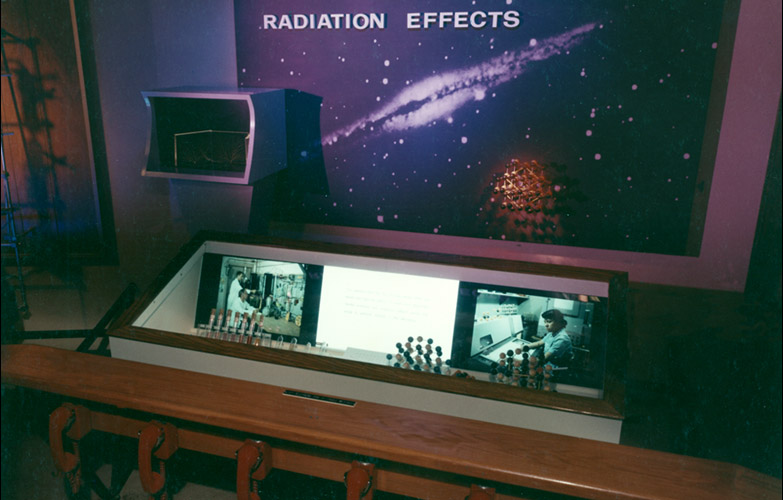
Radiation Effects – Three-dimensional models demonstrated the changes (both harmful and beneficial) that took place in the molecular structure of plastic and other materials due to exposure to radiation.
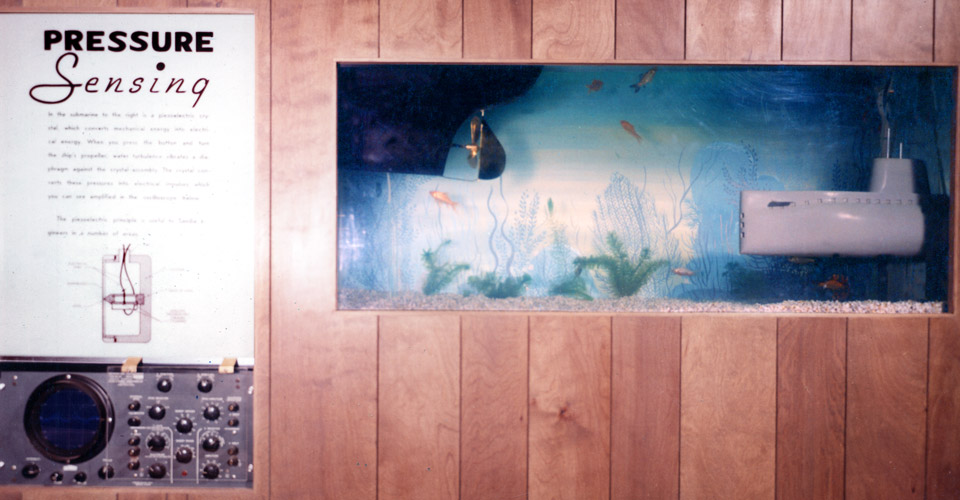
Pressure Sensing – The viewer pressed a button that activated a propeller of a ship. This pressure was then detected by a pressure sensing device and piezoelectric crystal located in the prow of a mock-submarine. The piezoelectric crystal emitted electrical impulses that could be viewed by an oscilloscope. The exhibit explained how that technology could be used by submarines to detect surface vehicles.
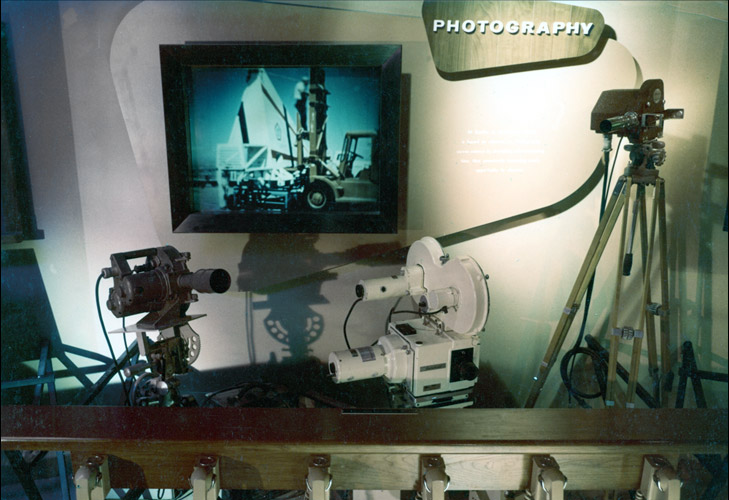
Photography – SNL used high speed photography to capture the results of many of its field tests. This display showed samples of high speed photography taken at different SNL test facilities—ballistic drop tests, sled track tests, and parachute drops.
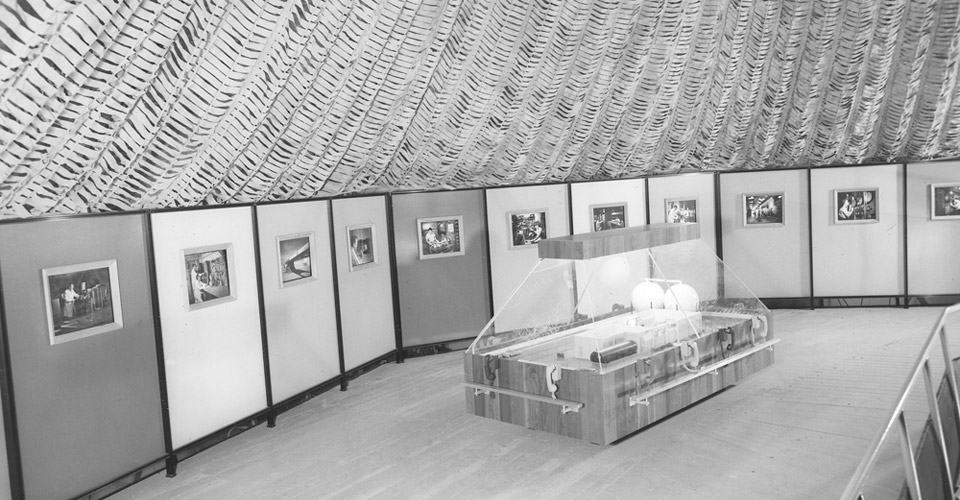
Wind Tunnel – A model of SNL’s hypersonic wind tunnel was displayed on the Sphere’s mezzanine. The real wind tunnel could expose models of weapons and rockets to wind velocities up to Mach 11 (Mach 1 equals 760 mph) and temperatures up to 2500º F.
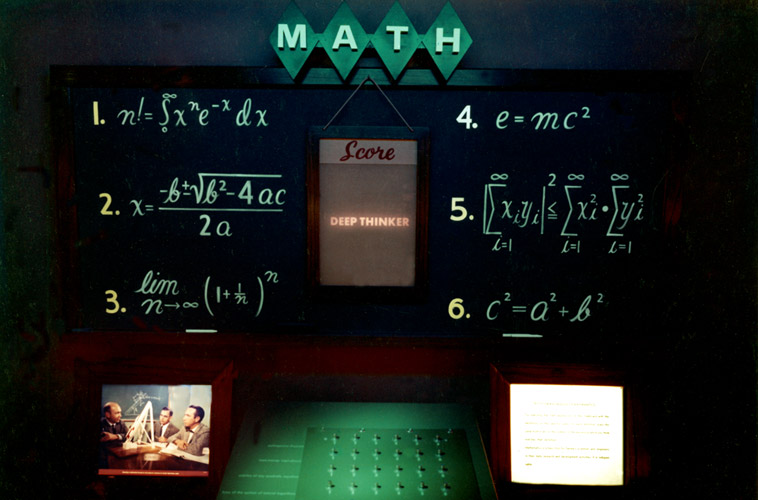
Mathematics – This was an interactive exhibit exploring mathematical equations used in SNL’s work in the areas of applied mathematics, systems analysis, statistics, and numerical analysis.
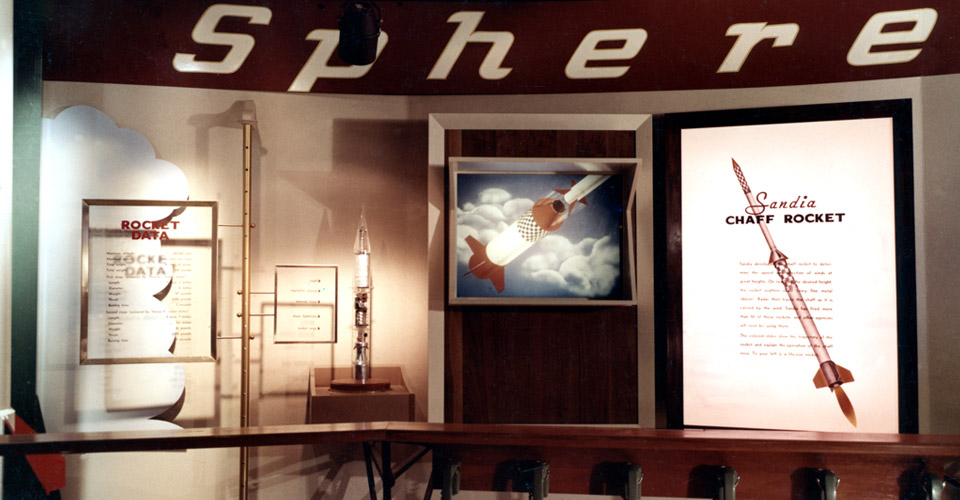
Aerodynamics – One aerodynamics display featured comparisons of 16 th century aerodynamics with Atomic Age developments. Murals depicted Leonardo da Vinci’s drawing of a balloon and SNL’s chaff rocket, used to measure conditions in the atmosphere. In another aerodynamics display, viewer could test his or her knowledge of aerodynamic principles in different areas of SNL’s work. The problems that visitors solved had to do with shock wave formation, engines, aerodynamic shape, airfoil section shape, and airflow equations—all practical problems encountered in weapon development.
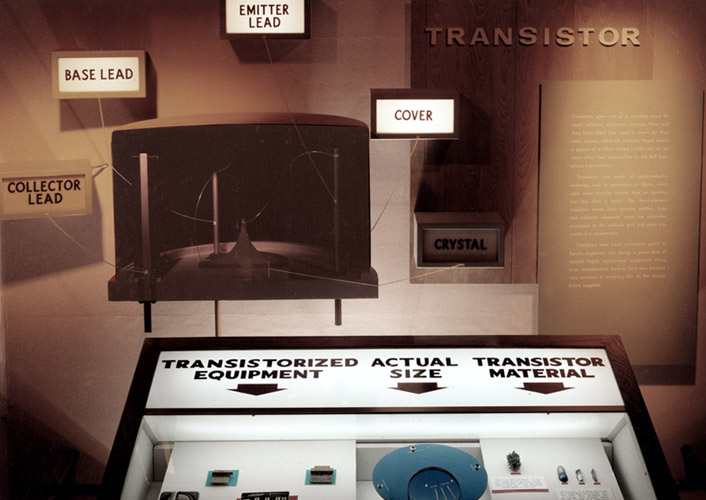
Transistor – Transistors were minute and efficient electronic devices on a weapon system—they replaced earlier vacuum tubes. A transistor 100 times its actual size featured in the exhibit. There was also a life-sized transistor that visitors could examine under a microscope.
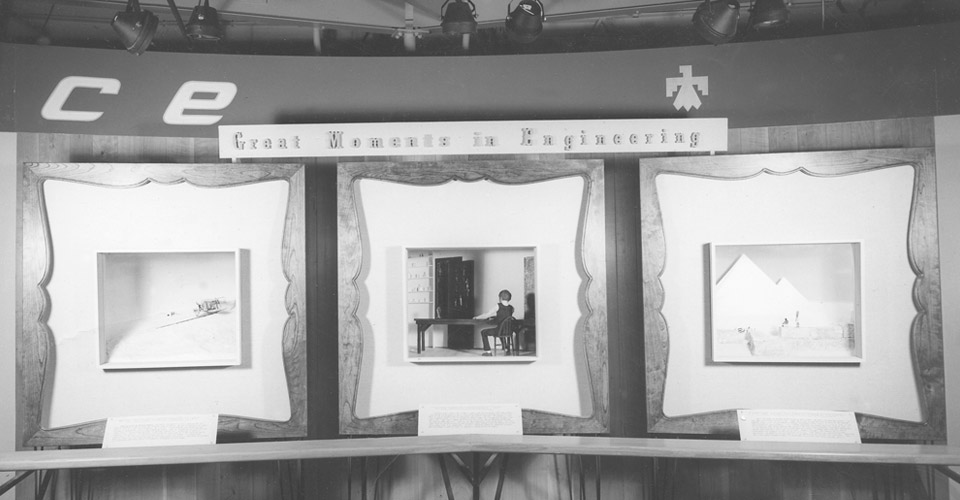
Great Moments in Science and Engineering – Six dioramas depicting the achievements of the Egyptians, Curies, Newton, Copernicus, Edison, and the Wright Brothers lined the hallway connecting the Sphere with the Thunderbird Theater, where “The Sandia Story” explained Sandia’s mission and facilities.
Outreach
In 1950, Sandia established a Public Relations Division to better coordinate the release of information with the Atomic Energy Commission, meet the desire of Albuquerque citizens and public officials to obtain accurate information on Sandia’s programs, and generally maintain sound community. Over the years, the Public Relations Division converted the internal Sandia Weekly Bulletin into the more widely distributed Lab News, provided official media releases, fostered participation in community projects and events, developed exhibits on Sandia’s work to be displayed in the community, arranged tours of unclassified work sites, published a variety of i-house newsletters and pamphlets, and ensured Sandia participation in the New Mexico State Fair.
After the success of the borrowed geodesic dome as an exhibit space at the 1958 State Fair, Sandia obtained its own dome and installed it in May 1959 as the Sphere of Science. The Sphere served as an introduction to Sandia for visitors and dignitaries, offering the public (including the families of employees) an opportunity to see and understand Sandia’s programs.
In 1968, the Sphere of Science exhibits were removed and shipped to the Hall of Science in New York City for a year of display. New exhibits were prepared and installed in the Sphere of Science.
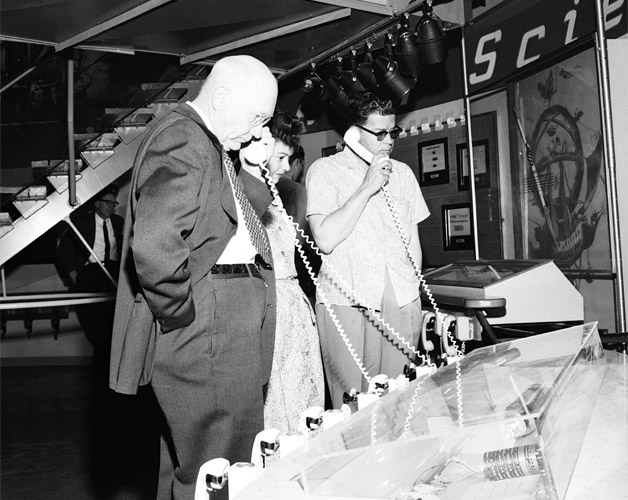
1961 – Members of the Rocky Mountain Psychological Association toured the Sphere of Science as part of its annual convention program.
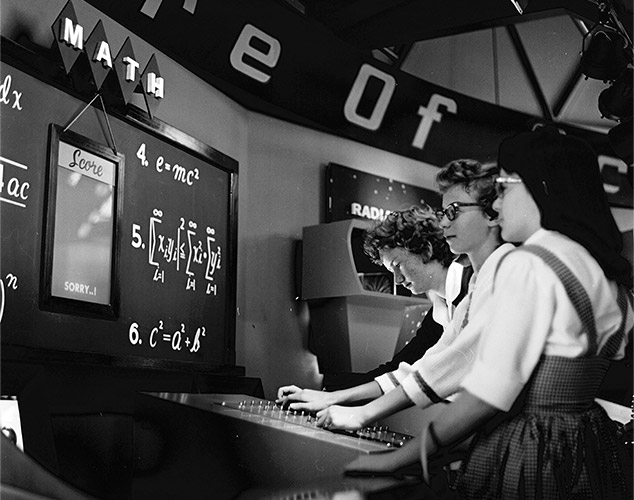
1962 – Members of the Franklin Junior High School Science Club of Grants toured the Sphere of Science and other Sandia facilities.
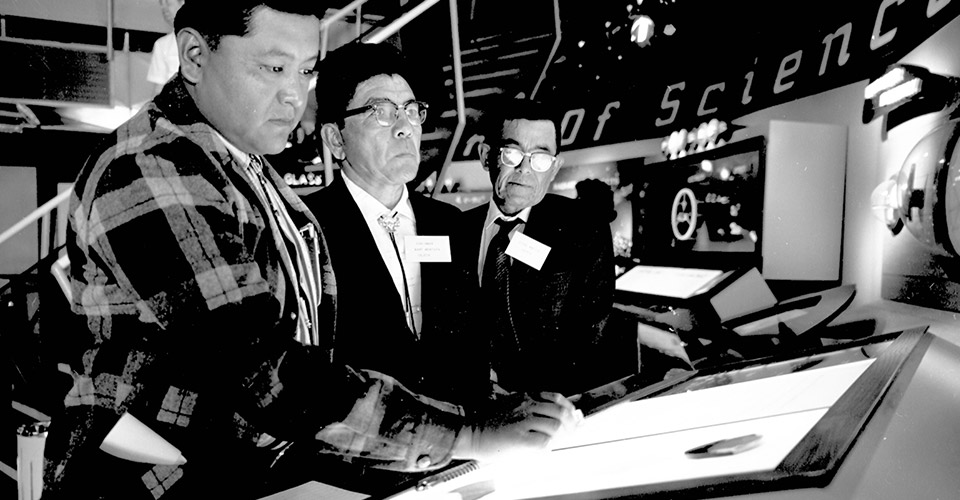
1965 – Representatives of the All-Pueblo Council, Mescalero and Jicarilla Apache Tribes, and the Navajo Tribe visited the Sphere of Science.
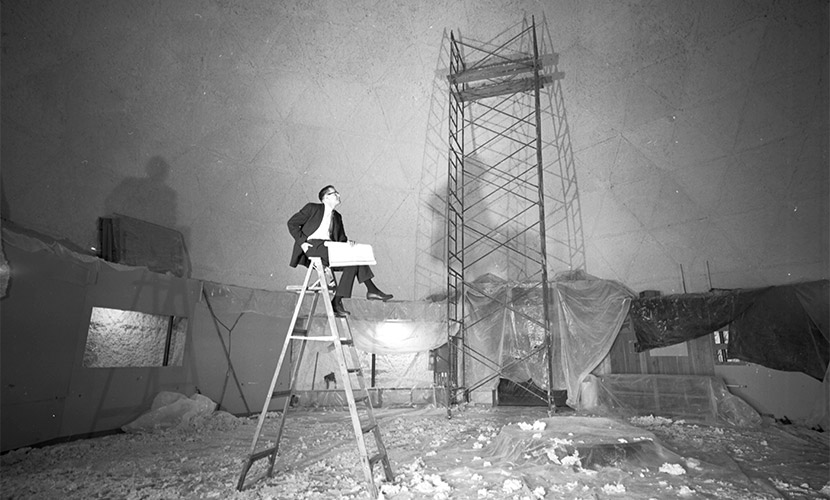
1968 – In 1968, the exhibits were removed and the dome was renovated. Ken Sutton led the redesign effort.
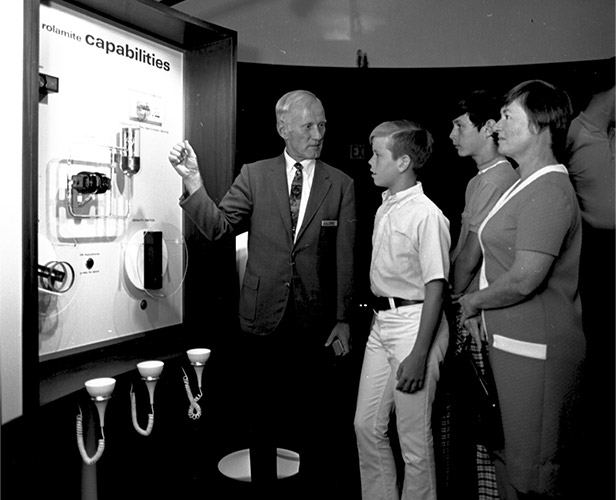
1970 – Sandians and their families were invited to visit the renamed Sandia Laboratories Exhibit Center during the noon hour. Guides provided tours of the new exhibits.
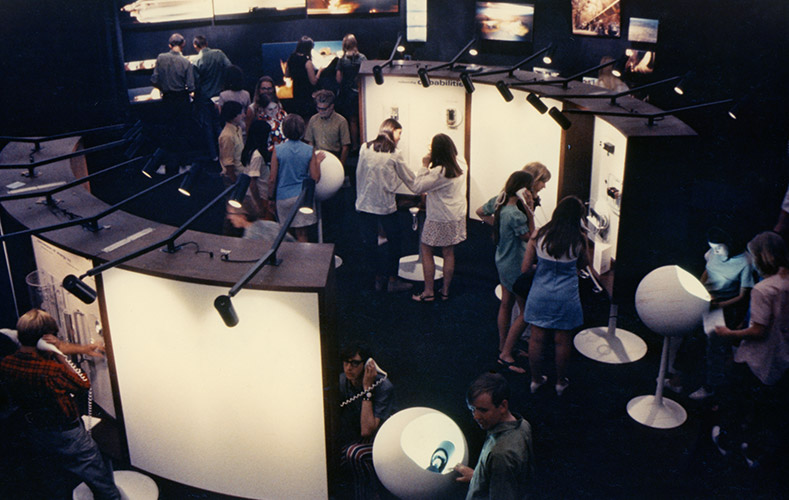
1971 – Student visitors to the Sphere of Science in 1971. By the early 1970s, the exhibit designs were less Sputnik and more modern industrial slick, as illustrated by the egg-shaped information stands near the exhibits.
Building Design
The building was constructed of fiberglass triangles bolted together to form a ¾ sphere. Inspired by a dome originally designed by Walther Bauersfeld, chief engineer of Germany’s Carl Zeiss optical company just after World War I, R. Buckminster Fuller patented the geodesic dome design in 1954 and popularized the domes in the U.S. The dome’s extreme strength compared to its weight made it ideal for use in harsh environments and the design was deployed in auditoriums, weather observatories, and storage facilities. In 1956, the domes were used in the Distant Early Warning System (DEW Line), an air defense system stretching across the Arctic, intended to detect manned bombers attacking the U.S. The DEW Line domes could withstand heavy loads of snow and winds up to 200 mph.
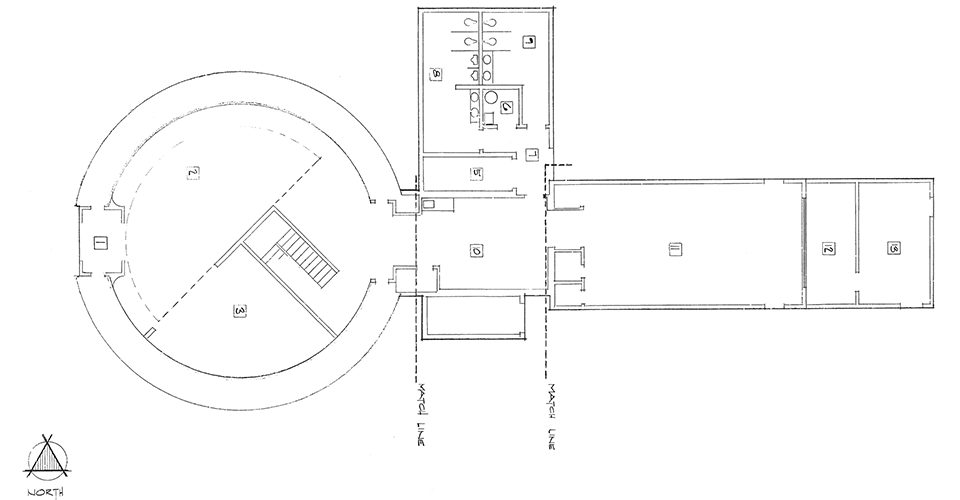
The dome Sandia installed in 1959 was made of bolted-together fiberglass triangles with flanges on their inner edges. The west side entrance was shaped like the Sandia Thunderbird and was surrounded by a metal mesh awning. A rectangular 70-seat metal theater extended from the sphere’s east side, accommodating film viewings and meetings. The theater attached to the east side of the dome by means of a concrete masonry unit vestibule. The vestibule was flanked on the north side by a mechanical room and the south side by a storage room.
By 2002, the dome had undergone minor and major renovations. The Thunderbird shape around the west side entrance was removed. The sweeping curved double staircases to the mezzanine was replaced by a single central stairway with a half-turn stair with one landing halfway up. The mezzanine was turned from a floor circling the second level of the dome to a floor extending halfway across the dome. The floors were carpeted and the theater was emptied and used as a large meeting and/or exercise room.
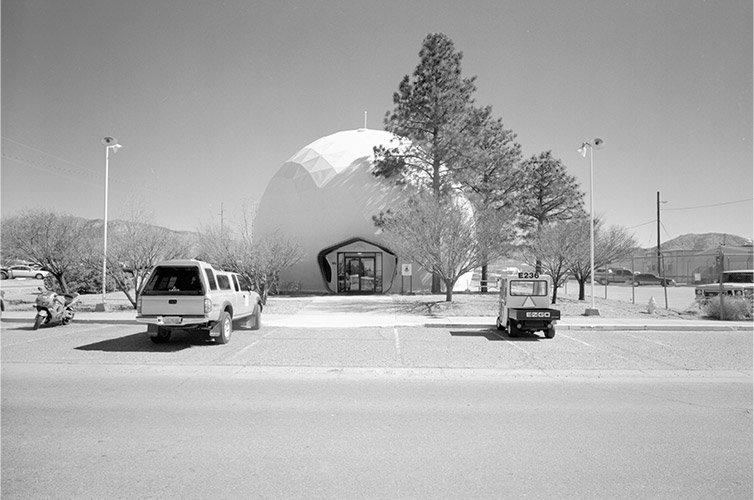
West side of dome from the street. Main entrance with glass-paneled double door and mesh awning surrounding entrance. The entire structure was 40′ high and 55′ in diameter.
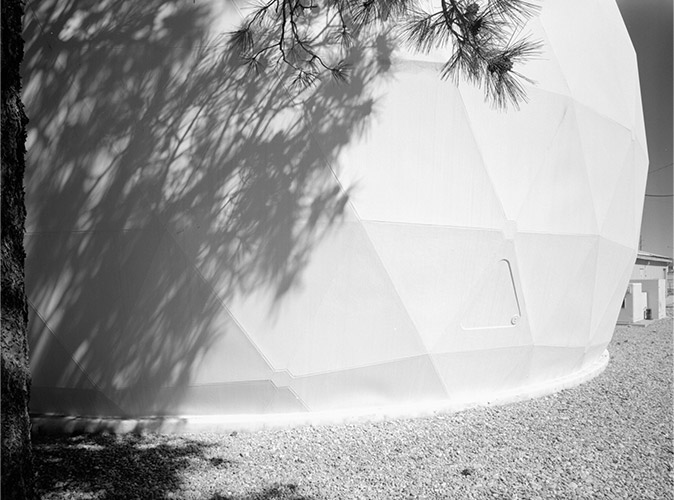
Southwest edge of dome, close-up of exterior wall showing construction of triangular panels. Each fiberglass triangle measured approximately 5′ 8 7/8″ x 5′ 4 5/8″ x 5′ 4 5/8″.
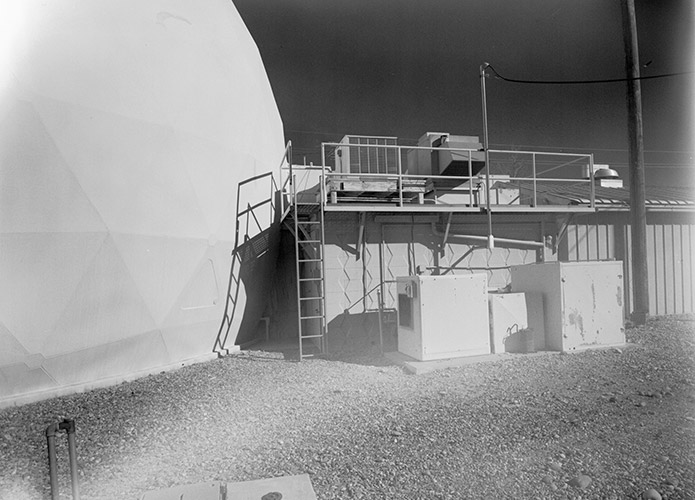
South side of dome and 22′ 8″ x 26′ concrete block vestibule. Metal access ladder to HVAC units on roof of vestibule.
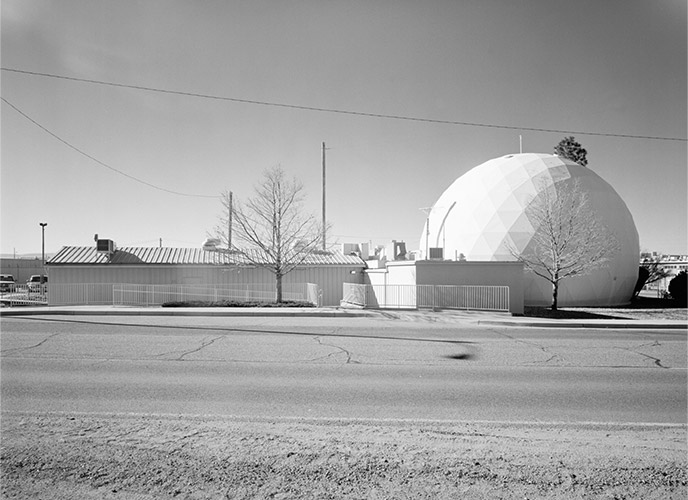
North side of structure, showing arrangement of dome, vestibule, and theater sections of the building.
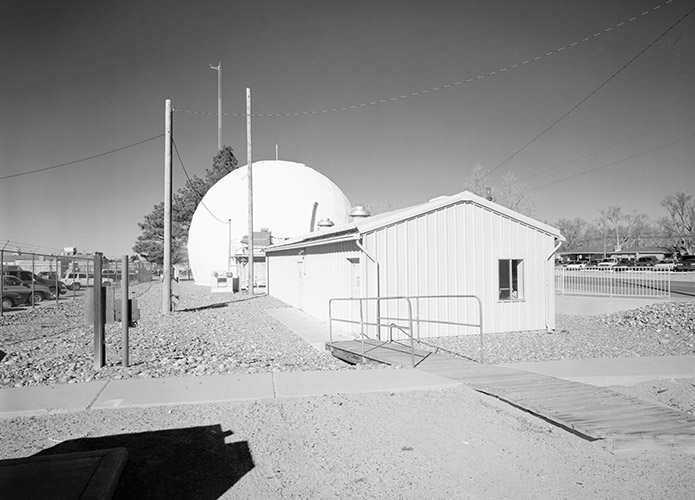
South side of structure; south side and east end of theater in foreground. Theater was 42′ x 20′.
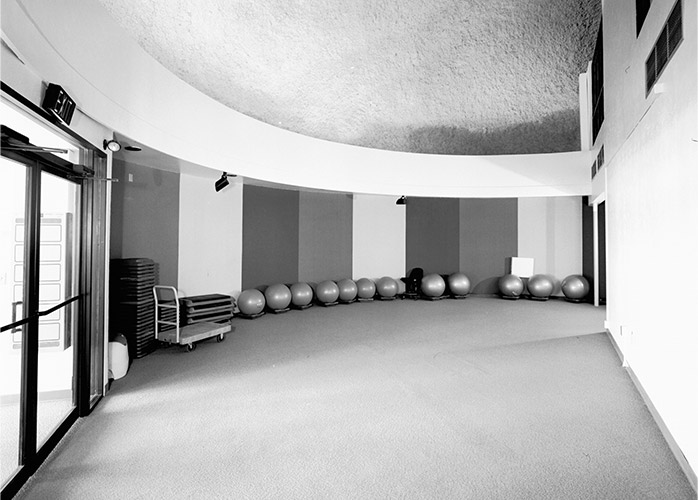
Looking northeast inside dome. Walls are gypsum board with track lighting, acoustical ceiling plaster on upper portion of dome.
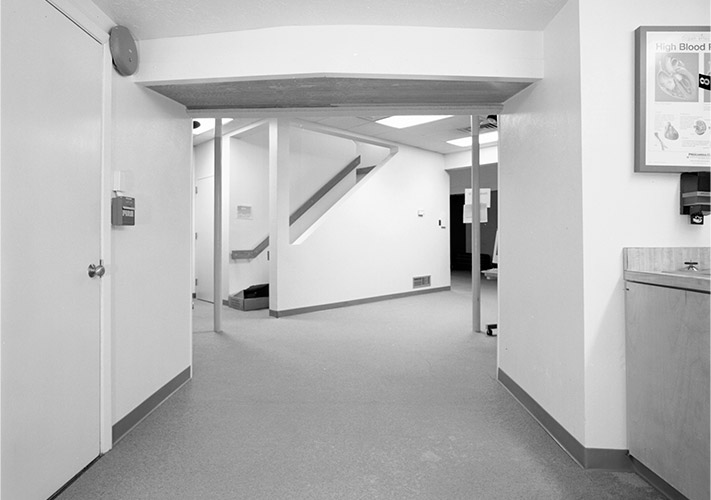
View from vestibule, looking up at beam ceiling and on into dome section with stairway to mezzanine in background.
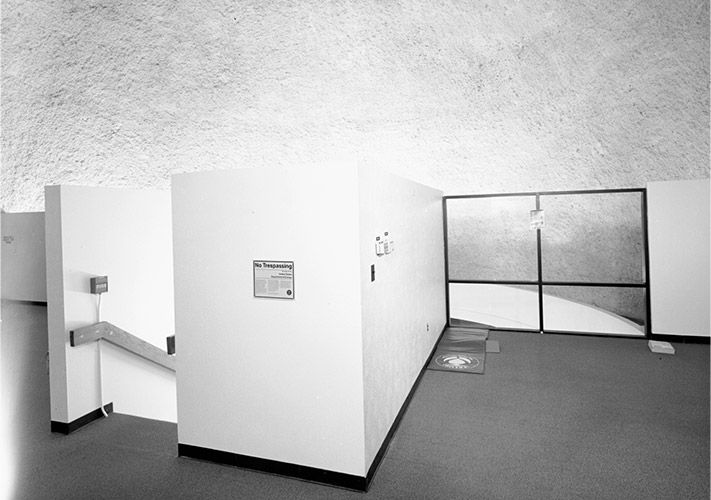
View from south edge of mezzanine. Gypsum walls, industrial carpet, Lexan windows.
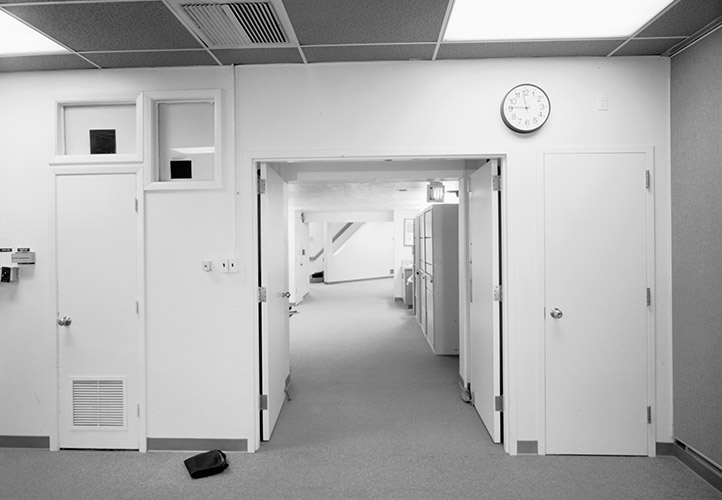
View from west end of theater into vestibule and on into center of dome where the stairway was located.
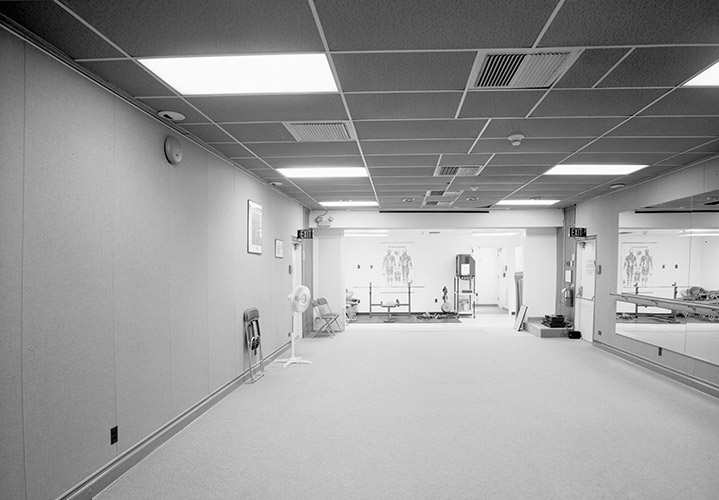
View from east end of theater through entire room. This is the metal Butler-type building attached to the east side of the dome via the vestibule.
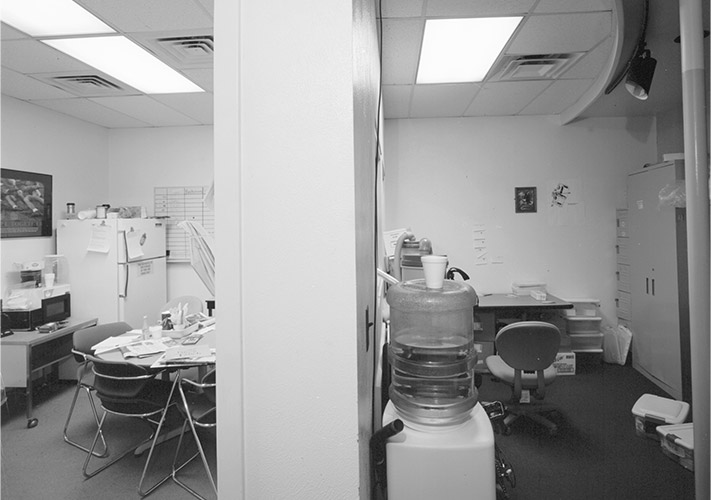
View from the south side of the storage room, used in later years as a break and locker room area.
In 1970, Sandia officially changed the Sphere’s name to the Sandia Laboratories Exhibit Center. The Exhibit Center continued to be an entry point for the visiting public and to receive large groups of visitors on Family Day. However, by 1976, the Public Relations Division found it no longer had a use for the Exhibit Center. The building increasingly served as a site to brief foreign visitors on security procedures and less as an exhibit center for visiting groups. In 1978, SNL remodeled the building to house the Community Relations Division Staff, which used it until 1990. From 1990 until its decontamination and decommissioning in 2002, the building housed a miscellany of groups, including Radio Sandia and Sandia’s exercise programs.