skip to: onlinetools | mainnavigation | content | footer

Newsroom

Sandia Technology logo A quarterly research and development magazine.

Spring 2007
Volume 9, No. 1

SANDIA TECHNOLOGY MAGAZINE

alaska map
LDRD logo


Understanding climate change

barrow, alaska, sunset
High latitudes present a winter window into space. Photo captures a Barrow, Alaska, sunset. (Photo by Rune Storvold Geophysical Institute, University of Alaska-Fairbanks)

Sandia researchers Mark Ivey and Bernie Zak are members of a research team from around the world whose work on the cold tundra of northern Alaska is helping to transform scientific understanding of the Earth’s future climate.

The North Slope of Alaska site covers the area just east of Barrow along the coast of the Chukchi Sea. The area provides researchers with a rare, ground-based window into the cloud and radiative processes that occur in the earth’s atmosphere at high latitudes.

Sponsored by the DOE’s offices of science and biological and environment research, the Atmospheric Radiation Measurement Climate Research Facility, or ACRF, operates two research sites at its North Slope locale — Barrow and Atqasuk. The research performed at these sites has made it one of today’s most successful atmospheric programs.

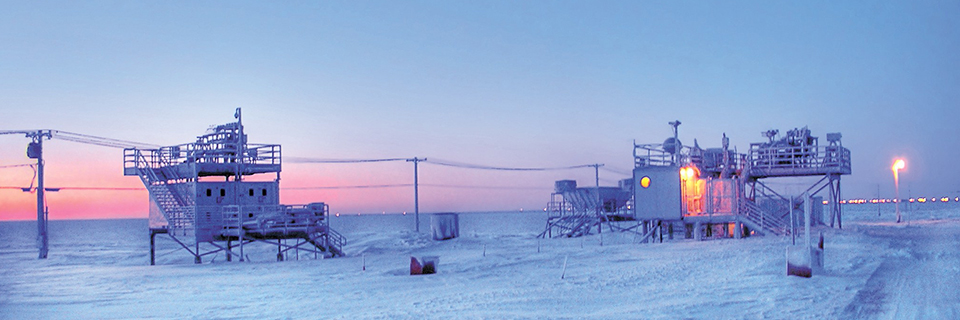
instrument cluster
Instrument cluster for guest researchers at ACRF research station. (Photo by Mark Ivey)

The Barrow site in particular will serve as a center for atmospheric and ecological research as part of scientific activities taking place during the International Polar Year, 2007-2008. During this time, scientists from around the world will focus their research on the Arctic and the Antarctic.

Arid cold window

“The arid cold during winter at the North Slope provides a ‘window’ into space. Under these conditions, infrared radiant energy can escape more easily through the atmosphere — it’s something that’s part of the earth’s natural energy balance,” says Zak, Sandia science liaison for the site. “This is one of the ways that high latitudes are quite different from temperate or tropical regions, and reinforces the importance of our research here.”

mark ivey
Site manager Mark Ivey at the North Slope site. (Photo by Eli Mlawer)

“Because the North Slope site is fairly cold year-round, we often observe clouds that are composed of ice or ice and water in mixed phases,” says Ivey, the site manager. The value of these different regional factors is that the researchers have the chance to study how longwave energy gets trapped to varying degrees in the atmosphere by different chemical constituents and conditions. These include water vapor, carbon dioxide, methane, nitrous oxide, chlorofluorocarbons, and liquid water droplets that absorb the energy emitted by the surface of the Earth.

The site is a national user facility for interdisciplinary studies of earth systems operated by ACRF. Along with sites in the U.S. southern Great Plains and the tropical western Pacific, these primary, fixed locations are equipped with an extensive array of instruments for obtaining atmospheric data. In 2005, the ACRF added a mobile facility to its suite of research capabilities.